Scour protection, berth deepening, foundations and marine sealing. Concrete, formed in place underwater, shaped to the structure and installed without heavy marine plant.
Marine construction since 1965
Projects from Europe to Antarctica
Published in PIANC, ASCE & ICE
Foundations for the MOSE flood barrier, Venice
The applications we are most often engaged on. Select the one that matches your structure for detailed guidance, or view the full range below.
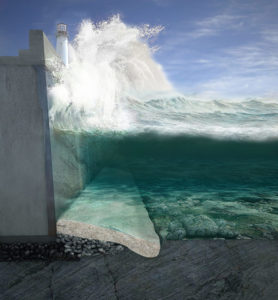
Powerful modern vessels scour the seabed at the berth, undermining the quay. A thin, sealed concrete apron stops it at source.
Explore
Accommodate larger vessels by gaining depth from the structure you already have.
Explore
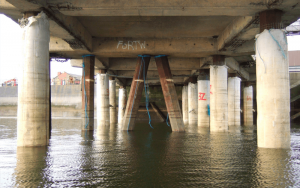
Grout-filled fabric forms create bearing foundations, hard points and pile connections.
Explore
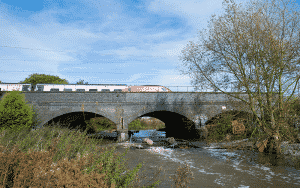
Grout bags and sock seals close gaps, seal between caissons and repair piles underwater.
ExploreEvery application above is the same idea, formed differently: shape a fabric form to the job, fix it exactly where it’s needed, and fill it with concrete in place. A scour mattress, a foundation bag and a sealing sock are all that one technique.
Every form is designed and fabricated to the geometry and loading of the structure it serves, from scour aprons and slope mattresses to foundation bags and sock seals.
The form is fixed where it is needed and pumped full of concrete or grout from the quay, deck or barge. No dewatering, no heavy marine plant, no batching at the bed.
Filling is monitored from above, with vents confirming full contact before pumping stops, proven from harbour repairs to the foundations of the MOSE barrier.
Thinner than the equivalent rock armour section
Propeller jet flow the protection is proven against
Deepest berth protected · Ashdod, Israel
Design life available, sealed against the seabed
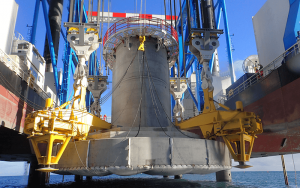
Foundations for the mobile flood barrier protecting Venice. Grout bags filled entirely from the surface, with no divers, seated 20,000-tonne caissons to gate-alignment tolerance.
Foundation interfaces for every marine pier of the 5.4 km offshore viaduct: 3,500 m³ of grout placed from the surface in cyclone-exposed waters.
Our largest concrete-mattress install. At 200 mm, the protection used a fraction of the rock armour an equivalent specification would have demanded.
Most projects reach us through a consulting engineer or a contractor. We design, fabricate and supply the system; installation is by your team, with our engineers supervising on site.
Every project is assessed on its merits. When another solution serves your structure better, we will say so.
Fabric-formed concrete is concrete or grout pumped into a woven fabric form that has already been placed in its final position, underwater or against a structure. It sets where it is filled, rather than being made elsewhere and lowered in.
The fabric is grout-tight but lets water through. Under pumping pressure the free water bleeds out while the cement and sand stay in, lowering the water-cement ratio, so the cured concrete is stronger than the mix that entered the pump and sets without washout in open water. Proserve have used the method in marine construction since the 1960s, in three forms. Concrete mattress for scour protection, grout bags for foundations, and grout socks for sealing gaps.
Proserve designs and supplies fabric formwork systems that protect marine structures from scour and erosion, and support them underwater: in situ concrete mattresses, foundation grout bags and bespoke structural seals.
The systems are used on quay walls, piled jetties, bridges, revetments and breakwaters worldwide. Proserve engineers each solution, fabricates it, and supports the contractor who installs it.
Proserve’s systems are installed by the contractor’s own divers, trained and supported on site by Proserve’s engineers. Proserve designs, engineers and fabricates the system; the marine team installs it.
Clients get a specialist-engineered solution installed by their own team, with Proserve alongside from planning to completion.
Proserve works with consulting engineers, marine contractors, dive teams, and ports worldwide.
Engineers come to Proserve for design support and specification input. Contractors come for the fabricated system, installation planning and on-site support.
Proserve has engineered fabric formwork for marine construction since the 1960s, led by chartered civil and structural engineers, with its research on berth scour presented to PIANC world congresses.
The systems are designed for constructability as much as performance, installed by local dive teams from the quayside, without marine plant, with Proserve training and support on site.
Send us what you have: bathymetry, vessel type, structure, design life. Your enquiry goes to our engineers, whether you are specifying the protection or pricing its construction.