Case Studies

Ashdod, New 17m Deep Container Berths

Ashdod, New 17m Deep Container Berths

Israel
PMEC (China Harbour)
Concrete Mattress
2017-2020

Project Overview

PMEC, a subsidiary of China Harbour Engineering Company, undertook the construction of a major marine infrastructure development at the Port of Ashdod, Israel. The Hadarom Port Project involved: 

  • A 600m extension of the existing breakwater 
  • A new 1,500m breakwater 
  • Construction of two new container quays, Quay 27 and Quay 28 

The terminal was designed to accommodate the new generation of 20,000 TEU container ships, which could not previously berth in Israel. With a berth depth of -17.3m, the port provided the capacity and draft clearance required for the largest container vessels operating globally. 

Pre Construction Quays Constructed

Scour Protection Requirement

To safeguard the structural stability of the quay wall and preserve the bearing capacity of the foundation material, high-performance scour protection was required beneath the berthing area. The design called for:

  • A 300 mm thick in-situ concrete mattress extending 850 m along the quay and 39 m in width (approx. 33,000 m²)
  • Capability to berth two ultra-large container vessels simultaneously
  • Resistance to high-energy propeller wash and bow thruster forces from ships drawing up to 17 m
  • Sealed protection to prevent the loss of supporting material, critical to maintaining the integrity of the quay structure

In-situ concrete mattress technology was selected for its ability to deliver continuous, jointless scour protection across the entire area—offering a significantly thinner and more efficient alternative to conventional rock armour.

Ashdod Concrete Mattress Protection Area
Protection Area

Concrete Mattress Solution

The chosen scour protection system provided several engineering advantages:

  • Continuous Protection: The cast-in-place concrete slab eliminated joints and gaps, preventing localised erosion and anchor snagging.
  • Stability: The weight of the mattress and its interlocking structure resisted dynamic flows from propulsion systems.
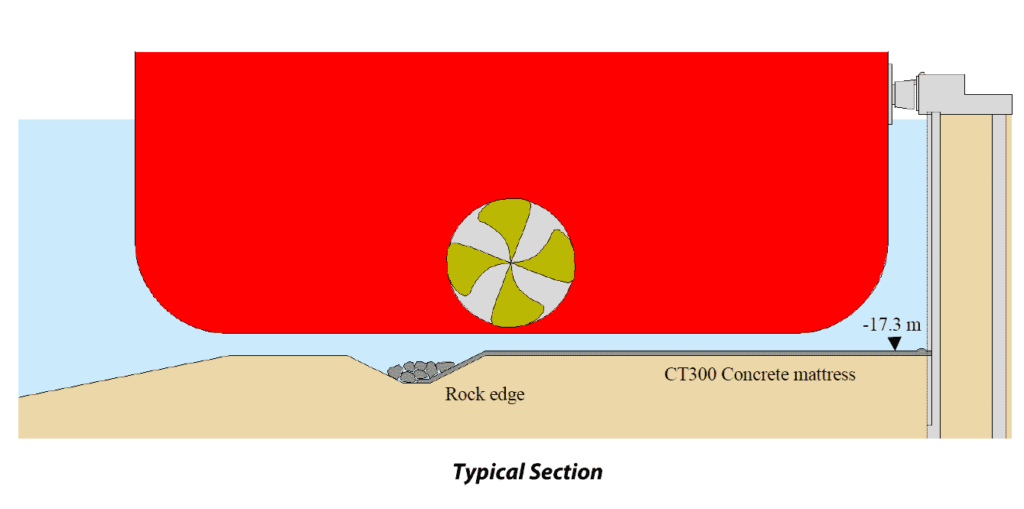
  • Edge Defence: A rock armour falling edge detail secured the perimeter, preventing under-scour and edge destabilisation.
Ashdod Cross Section
Cross Section

Mix Development & Site Trials

Extensive mix development and trial installations were conducted to ensure the concrete could be pumped reliably underwater. Proserve provided full-time site support during initial works, transitioning to remote guidance and interim visits as construction progressed.

Key testing parameters included:

  • Use of coarser-than-usual aggregates (0–10 mm) to reduce material costs
  • Full-scale underwater trials to test placement procedures and train dive teams
Ashdod Concrete Mattress Test Filling
On Site Demonstration Trial

Coordination & Installation Support

Proserve worked closely with contractors to support the installation:

  • On-site training and diver briefings were backed by detailed installation guides and drawings
  • Regular coordination meetings were held to ensure the system was installed correctly the first time—critical in a complex underwater environment

Concrete Mattress Lowered into Seabed

Mattress Filling Procedure

Each mattress panel was filled underwater using the following approach:

  • Divers inserted grout hoses into filling ports on the mattress
  • Pumping began at the deepest point (-20 m) and progressed upslope to the -17 m flat area, increasing flow rate as elevation rose
  • Each mattress panel was cast in approximately 2.5 hours
Installed Concrete Mattress

Project Completion

The installation was carried out in a series of phased milestones. The scour protection works were successfully completed in 2016, delivering a robust, low-maintenance scour solution for Israel’s new deepwater container terminal.

Concrete Mattress vs Rock Armour

Read about the advantages of concrete mattress over rock armour.